How Vehicle Transport Works in Alberta: Moving Cars, Trucks, and Classics the Right Way
By Jim Blake, Owner — Get'er Gone Transport and Hotshot Services
Transporting a vehicle is not the same as shipping a box. Whether you are buying a classic car out of province, relocating to Calgary from Edmonton, or sending a company truck to a job site in the Peace Country, getting the transport right means understanding your options, asking the right questions, and choosing a team you can actually reach when something comes up.
This guide walks through how vehicle transport works in Alberta, what to expect, and how to make a smart decision for your specific situation.
Why Vehicle Transport Is Different from Standard Freight
Most freight gets palletized, shrink-wrapped, and consolidated with other loads. Vehicles cannot — and should not — be handled that way. They have their own weight, dimensions, clearance requirements, and mechanical sensitivities. A transmission that drips fluid, a lowered suspension that scrapes ramps, or a paint finish that cannot touch a strap without a buffer — these are real considerations that a general freight broker may not think twice about but that matter enormously to you.
In Alberta, where distances are long, weather turns fast, and many deliveries go to industrial sites with limited road access, vehicle transport requires more than just loading it on a trailer and driving. It requires route planning, proper securement, communication along the way, and someone who picks up the phone.
Open Deck vs. Enclosed Vehicle Transport: Which Do You Need?
The most common question when arranging vehicle transport is whether to use an open trailer or an enclosed one.
Open deck transport (also called flatdeck or open trailer) is the standard choice for most vehicles. The vehicle is loaded onto an open flatdeck or tilt-deck trailer, secured with soft straps or wheel chocks, and transported exposed to the elements. It is the most common method used across Alberta for everything from pickup trucks and SUVs to work vehicles and construction equipment. It is also the most affordable option.
Enclosed transport offers full weather and road-debris protection. The vehicle rides inside a covered trailer, shielded from rain, hail, gravel, and winter road spray. Enclosed transport is the preferred choice for:
- Classic and vintage cars with original or restored finishes
- High-value or exotic vehicles
- Vehicles with low ground clearance that require ramp angle management
- Collector cars being transported for shows or private sales
- New vehicle deliveries for dealerships or private buyers who want showroom condition on arrival
In Alberta, where hail storms can strike in June and road spray runs thick in spring, enclosed transport is worth the premium for anything where the finish matters.
What the Transport Process Looks Like Step by Step
Understanding what to expect reduces stress on both ends of the move.
Step 1 — Quote and planning
A good transport provider asks about more than just where the vehicle is going. They want to know: Is it running or non-operational? What is the ground clearance? Are there any modifications (lifted, lowered, wide body)? Any fluids leaking? Is it going to a residential address, a business, a job site, or a storage facility? These details determine which trailer type is right and what load securement is needed.
Step 2 — Pickup and inspection
Before the vehicle goes on the trailer, both parties should document its current condition — a simple walk-around with photos of all four sides, the roof, and the underside if accessible. This is your baseline if any question about damage ever comes up. At Get'er Gone, we capture this at pickup and share it with you.
Step 3 — Securement
Proper securement for vehicle transport in Alberta uses soft tie straps at the wheels (not chains on bodywork), wheel chocks for stability, and — for enclosed transport — padded interior protection if there are any contact points. Cargo securement must meet Transport Canada standards for weight distribution and strap ratings.
Step 4 — En route communication
You should know when the vehicle has been picked up, roughly where it is in transit, and when to expect delivery. If anything changes — weather delay, route adjustment, a timing issue — your transport provider should tell you before you have to chase them.
Step 5 — Delivery and final inspection
At delivery, do a full walk-around again against your pickup photos before signing off. A trustworthy transport team hands the vehicle off in the same condition it was loaded, and can provide photo proof of delivery if you need documentation for insurance or a private sale.
Common Vehicle Transport Routes in Alberta
Alberta's geography shapes how vehicle transport is planned. Here are the most common routes we run:
- Calgary ↔ Edmonton: The QEII is Alberta's main corridor and the most-requested vehicle transport lane. Standard transit time is same-day or next day depending on pickup window.
- Calgary ↔ Lethbridge / Southern Alberta: Straightforward routes with good road access.
- Calgary ↔ Red Deer / Central Alberta: Frequent lane for personal and business vehicle moves.
- Calgary / Airdrie ↔ Mountain Communities (Canmore, Banff, Jasper): Mountain routes require route planning for large trailers and seasonal conditions.
- Calgary ↔ Grande Prairie / Peace Country: Longer-haul lane used for work trucks, oilfield vehicles, and equipment.
- Alberta ↔ British Columbia: Cross-mountain transport including routes through Kicking Horse Pass and the Crowsnest Pass, conditions permitting.
- Alberta ↔ Saskatchewan: Interprovincial vehicle moves for private sales and relocations.
If your route is not on this list, text us the lane — we confirm feasibility and timing before booking.
Who Uses Vehicle Transport in Alberta?
Vehicle transport in Alberta is not just for classic car collectors. The demand comes from a surprisingly wide range of people:
Private buyers and sellers. Online vehicle marketplaces have made it common to buy or sell a truck or car several hours away. Transport removes the need for a long highway drive to complete a private sale and gives both parties a cleaner, documented handoff.
Relocating families. When a family is moving from Edmonton to Calgary, or from Calgary to the Okanagan, transporting an extra vehicle separately is often more practical than adding a long drive to an already-busy moving day.
Dealerships and auction buyers. Vehicles purchased at auction in one city often need to be moved to a dealer or buyer in another city quickly and safely.
Classic and collector car owners. Collectors in Alberta transport vehicles to shows, storage facilities, restoration shops, and new owners across Western Canada regularly. Enclosed transport is the standard for this market.
Businesses with vehicle fleets. Work trucks, company SUVs, and service vehicles that need to be repositioned between offices, job sites, or service locations are a regular part of Alberta's commercial transport picture.
Oilfield and industrial operators. Crew cabs, service trucks, and light equipment that follow project timelines across Alberta's energy corridors need reliable, on-schedule transport.
How to Evaluate a Vehicle Transport Provider in Alberta
Not all vehicle transport services are equal. Here are the questions worth asking before you book:
Do they specialize in vehicles, or is it a general freight add-on?
Some companies offer vehicle transport as an afterthought to general freight operations. Ask whether they carry soft tie straps, have experience with your vehicle type, and can handle any quirks — non-running vehicles, wide bodies, low clearance.
What does their communication look like?
Can you reach a real person? Will they update you at pickup and delivery, or will you be refreshing a tracking page hoping for a status change? For a vehicle, especially a valuable one, you want a transport provider who picks up the phone and answers your questions directly.
Is there photo documentation at pickup and delivery?
This protects both you and the transport company. It should be standard.
What is their cancellation and rescheduling policy?
Things change — schedules shift, sales fall through, delivery windows need to move. Understand the policy before you commit.
Why Calgary and Airdrie Clients Choose Get'er Gone for Vehicle Transport
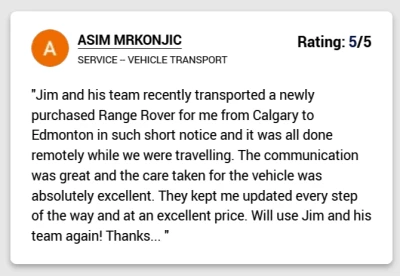
Get'er Gone Transport has moved everything from a freshly purchased Range Rover between Calgary and Edmonton to classic cars heading to restoration shops across Alberta. Here is what clients consistently tell us matters most:
Direct communication. You deal with Jim and the family team — not a dispatch centre or an automated portal. When something changes, you hear from us first.
Careful, documented handling. Every vehicle transport job begins and ends with a photo walkthrough. We use proper soft-strap securement, and for enclosed transport, we take the time to protect contact points.
Honest, all-in pricing. We quote based on what the job actually involves — distance, vehicle type, access, timing — with no fuel surcharge surprises added on invoice.
On-time follow-through. Our BBB A+ rating and 100+ verified five-star reviews reflect a consistent record of showing up, communicating clearly, and delivering what we promised.
If you need a vehicle moved across Alberta or into a neighbouring province, text or call us at 403-690-4636 or email bookings@getergone.ca for a clear, same-day quote.