How to Plan a Calgary Move Without Last-Minute Stress
Plan your Calgary move by assigning every item, access point, and delivery task a clear owner and next step before you book a truck, storage space, or moving support. A measured inventory, confirmed building access, weather-aware schedule, and written service scope will prevent most last-minute problems.
What should you decide before booking a U-Haul moving and storage plan in Calgary?
Decide who is responsible for packing, loading, transport, storage access, unloading, and final placement before booking equipment or storage. A self-managed U-Haul moving and storage plan can work well for clearly labelled household goods and straightforward access, but it becomes harder when the move includes heavy furniture, appliances, narrow stairs, multiple stops, or a long route between Alberta communities.
Start with an inventory that separates ordinary boxes from heavy furniture, appliances, fragile items, single-item deliveries, office equipment, and cargo requiring special handling. Record dimensions where they affect doors, elevators, vehicle capacity, or storage layout. In Calgary, also document apartment elevator bookings, loading zones, alley access, parking restrictions, stairs, condo move requirements, and exposure to snow, wind, or rain.
Map the move from pickup to final placement
Map each item from its pickup room to its final placement, including who will carry it, where the vehicle will park, and whether it needs storage access between locations. Measure doorways, stair turns, elevator interiors, and hallway clearances before moving large furniture. This plan helps identify whether room-of-choice placement is practical and whether a direct transport provider should review the route.
Separate self-managed tasks from transport tasks
Keep simple packing, labelling, and light-box preparation self-managed when you have enough time and safe help. Consider professional support from Get'er Gone Transport and Hotshot Services for heavy furniture, tight access, urgent deliveries, specialty cargo, intercity routes, or tasks that involve repeated lifting. Confirm the exact scope instead of assuming packing, assembly, disassembly, cleanup, or storage handling is automatically included.
How can you build a Calgary moving schedule that leaves room for delays?
Four-stage moving timeline showing planning, booking, packing, and moving-day bufferRegenerate
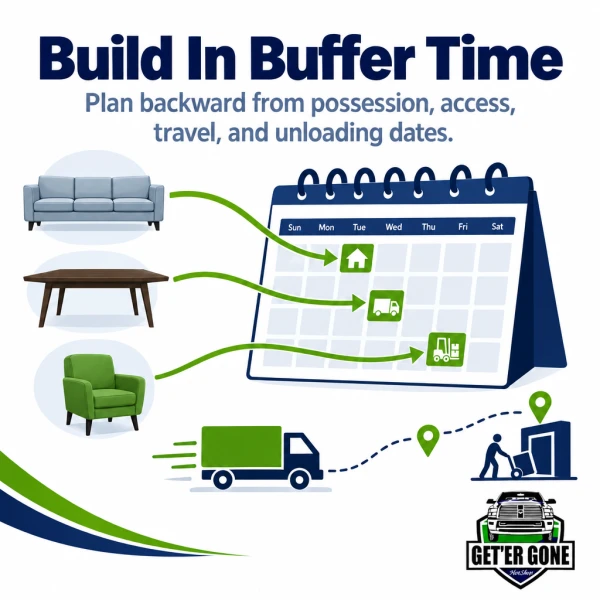
Build the schedule backward from possession, lease, elevator, and travel dates, then leave buffer time for loading, traffic, weather, and access changes. Start at least four weeks before moving day when possible: remove unwanted items, confirm the route, request storage information, and begin packing non-essential belongings. As the date approaches, arrange address changes, reserve an elevator or loading zone, label every room, confirm vehicle capacity, and schedule final cleaning.
Calgary conditions can change the practical timing of a move. Winter snow may slow loading and make sidewalks or alleys difficult to use; spring road conditions can affect rural and intercity routes; summer demand can limit preferred dates; and construction detours can alter arrival instructions. Longer trips between Calgary, Airdrie, Cochrane, Canmore, and other communities require more planning than a short apartment move.
Calgary move planning sequence
- Confirm the move date, possession time, route, and responsible contact.
- Measure doors, elevators, stairs, loading zones, parking areas, and large items.
- Reserve storage and confirm access rules, hours, contact procedures, and required protection.
- Declutter, pack non-essential items, and label boxes on multiple sides by room.
- Verify vehicle capacity against the measured inventory and separate priority items.
- Reconfirm loading, unloading, room placement, timing, weather exposure, and paid add-ons.
Work backward from possession and key dates
Set the loading deadline early enough to protect the possession or lease handover time, not merely the moment you expect the truck to arrive. Give yourself a separate window for cleaning, key exchange, elevator access, and a possible delay between storage release and final delivery. For intercity or interprovincial relocation, confirm the route and load details before treating any date as final.
Confirm access, equipment, and communication
Confirm the vehicle, parking instructions, elevator reservation, loading zone, storage location, and contact person several days before the move. Ask the responsible provider to review route conditions, item dimensions, access limitations, timing needs, and paid add-ons. A clear communication plan with milestone updates is especially useful for commercial moves, multi-stop deliveries, and valuable or fragile items.
What daily routine keeps belongings safe in moving or storage?
Inspect the moving or storage setup each day, keep aisles clear, check furniture covers and boxes, look for moisture or condensation, and update the inventory whenever an item changes location. Leave access space around stored belongings so you can inspect the back and sides without moving an unstable stack. Keep heavy boxes low, avoid overloaded piles, and use clear labels on more than one side.
Mattresses and upholstered furniture need clean, dry protection with enough ventilation to reduce trapped moisture. Keep appliances secure and upright when their handling instructions require it, protect electronics and documents from temperature or moisture exposure, and separate items that need more controlled conditions. Fragile, antique, damaged, custom-built, or modified furniture should receive a handling assessment before transport or storage rather than an assumed guarantee.
Check the space and labels each day
Check that aisles, doors, emergency access areas, and the route to priority items remain clear. Replace labels that have detached or become unreadable, and update the inventory when boxes are opened, consolidated, or moved to another storage position. A quick daily check can reveal a leaning stack, crushed carton, blocked access point, or moisture concern before it affects more belongings.
Protect furniture from shifting and moisture
Use suitable covers and secure items so they cannot slide, tip, or rub against one another during movement or temporary storage. Keep heavier pieces stable at the bottom, avoid compressing upholstered items under weight, and allow airflow around covered furniture where conditions require it. Photograph pre-existing marks on fragile or damaged pieces and share those details before handling begins.
Which storage and handling tasks need professional help?
Professional help is appropriate when the move includes oversized furniture, narrow stairwells, strict elevator dimensions, multiple stops, office equipment, construction materials, vehicles, or urgent delivery requirements. These situations combine weight, access, timing, and placement risks that are difficult to solve by estimating from a truck size alone.
Before requesting support, prepare dimensions and approximate weight, photos, pickup and drop-off addresses, stair and elevator details, parking conditions, desired room placement, and any assembly or disassembly needs. Get'er Gone supports residential and commercial moving, furniture delivery, custom transport, hotshot delivery, job site deliveries, and intercity or interprovincial courier work in confirmed service areas. Room-of-choice placement may be considered when safe and practical.
Professional packing, loading, unloading, unpacking, furniture staging, and post-move cleanup are available as part of the moving process, but the exact scope should be confirmed for the specific job. Paid add-ons such as assembly, disassembly, packaging removal, or other special handling should be discussed before booking rather than assumed.
Assess weight, access, and placement risk
Ask for a professional review when a piece is too heavy for the available helpers, too large for the elevator, difficult to turn through a stairwell, or intended for a precise room placement. Share photographs and measurements before the move so the provider can consider parking, carrying distance, floor protection, and safe handling. This is particularly useful for appliances, large furniture, office fixtures, and items with existing damage.
Plan specialty and time-sensitive transport
Use a confirmed transport plan for urgent deliveries, job site materials, vehicles, commercial inventory, and intercity or interprovincial relocation. Provide the route, load description, timing need, contact people, and access instructions before expecting a delivery window. Get'er Gone can review hotshot transport, custom transport, vehicle transport, and intercity courier needs without treating availability or delivery timing as confirmed until the route and load are assessed.
What common U-Haul moving and storage mistakes create last-minute problems?
Most last-minute problems begin with an unmeasured load or an incomplete access plan. Common errors include estimating truck capacity without measuring furniture, ignoring door and elevator dimensions, booking too little loading time, placing heavy items on weak boxes, and leaving belongings exposed to Calgary weather. When one of these problems appears, pause loading, remeasure the route, separate priority items, document the condition, update the inventory, and contact the responsible provider before continuing.
If pickup or drop-off details change, verify the route, access instructions, storage location, contact person, and revised timing directly. Do not rely on an old text message or an assumption that the new location has the same parking or elevator access. Photos, room labels, a simple load map, and milestone communication provide useful control for higher-value, fragile, commercial, or multi-stop moves.
Troubleshoot access and capacity issues
When furniture will not pass through a doorway or the vehicle appears too small, stop rather than forcing the item or overloading the truck. Measure the item, route, elevator, and available vehicle space again, then identify which pieces can be stored, delivered separately, or handled by a professional provider. Confirm any disassembly requirement and paid add-on before work begins.
Correct damaged labels, missing items, and schedule gaps
Compare the physical load with the inventory and photographs whenever a box is missing, a label is damaged, or timing slips. Mark priority items, record visible condition, confirm the current contact person and location, and request a revised sequence before the next move stage. A short written update is safer than relying on memory during a busy loading day.
When should a Calgary mover or transport provider take over?
Call a mover or transport provider when lifting becomes unsafe, vehicle capacity is insufficient, access is blocked, stairs are narrow or steep, items are fragile or unusually valuable, or the move includes multiple delivery points. Professional review also makes sense for urgent deadlines, intercity relocation, vehicle transport, commercial inventory, and job sites requiring coordinated delivery.
Get'er Gone Transport and Hotshot Services supports Calgary and nearby communities such as Airdrie, Cochrane, Canmore, and Rocky View County, along with confirmed Alberta and Western Canada routes. The team’s direct handling and communication model is designed to reduce coordination gaps by discussing the inventory, route, access, timing, securement, milestone updates, and proof of delivery where appropriate. Availability, timing, and add-ons still depend on the confirmed route and load.
Use a clear escalation checklist
Escalate when you cannot safely lift an item, cannot verify vehicle capacity, cannot secure a loading zone, or cannot explain how the item will reach its final room. Also escalate for fragile, damaged, modified, specialty, urgent, multi-stop, commercial, vehicle, and job site moves. A provider can then assess the handling requirements before the move reaches a preventable delay.
Prepare an accurate request for service
Send addresses, inventory details, dimensions, photos, access conditions, elevator or stair information, parking notes, desired placement, timing needs, and storage requirements. If you need packing, unpacking, staging, cleanup, assembly, disassembly, or special handling, state that clearly so the scope can be reviewed. Request a transport review from Get'er Gone, or contact the team at +14036904636 or bookings@getergone.ca before booking.